Tuesday, 3 April 2018

Chapter 91 : Not ball tampering


I watch the clouds attracted to the mountain. I ponder what animals they resemble and whether they will lead to rain. Will the rain be enough to stop us playing tennis? It was raining last night and a few puddles linger but they don’t restrict us.

A fence separates the birds in surrounding trees from the game of tennis. The tennis lines mark the limit of our game.  The court is a soft, smooth, comfortable surface. The net divides the court into two opposing areas.

I amble in. I am now number three. We can play tennis when number four turns up. I peer towards the car park looking for number four. Trying to see who it will be.  

Number four turns up and now we decide who is playing with who. And who is against who.  After one set we can either change partners or go for revenge.

The game starts when I throw the ball up and serve the ball down the middle of the court.  The guy receiving the ball hits the ball into the net and says, “You tampered the ball.”

We all have a good laugh. No serious cultural issues here. We are here to play sport.  We are with our friends to play sport.

The players are all different. A lady who slices everything. Every shot she returns low and short. She doesn’t move that quickly so I will try to make her move. I will attack her weakness.

A lady who hits every ball hard. She belts everything. She has a good volley. Very strong and sure. Never doubt her volley. Be wary if opposing her and confident if partnering her. Very friendly lady, I don’t doubt that.

And the final guy is just good at everything. He can play short or long. Spin it or hit it hard. Run or volley it. Everything he touches is good. And he is not arrogant or boastful. When you do a good shot he says, “Good shot.”
When the ball hits the net and drops over he says, “Sorry about that.”
He is too good for me but I like playing against him because I know I will get a good game. A good game well played.

After a couple of sets we have a break. Unlike the cricketers we all sup together.  Without any opponents. We are all together. On the court we were divided into opposition and teammates.  Now we are all on the same side. I can’t even remember who my opponent was.

One lady talks about her grandchildren. She talks about them playing soccer at the weekend.  They will eventually play against my grandson.  Another lady talks about her art. Yesterday she was painting a watercolor of the mountain. I would love to see it.

One guy asked me about what film I saw this week. I tell him and say, “I would give it four stars. Go and see it.”
He tells me what other films the director has made and says, “Sounds like he is back in form. Hitting winners again after a period of bad play.”

We return to the tennis for our final sets. Different opponents and different partners.

I find myself receiving. The server throws the ball and hits it down the middle. I move my left foot towards the ball and swing my racket back. The racket thumps the ball and I watch the ball. Is it going where I wanted it to go?
Hopefully to his backhand. He doesn’t like it deep and bouncy to his backhand. If he returns it he will go across court and I will be ready for that.

The other lady we are playing always tries to lob me.   I stand further back from the net making it more difficult for her.

I find myself playing with a guy I love to beat. I resent his court behavior but accept it.  We are now playing together and doing our best to win. 

I want a good game. I want long rallies. I want rallies were everybody runs and jumps and moves. Rallies involving everybody. A rally were nobody knows who is going to win. I want games where nobody knows who is going to win. I want an even set where the result is always in doubt.

Set point is announced. They win. We shake hands and depart. We have all had physical and social exercise.
The professional cricketers are on a planet where winning, marketing and money are important. Luckily we are on a different planet. I can’t even remember if I won.  I always try to win and improve my play. Work on my weaknesses. I need to be more consistent on the deep backhand. I reckon somebody has spotted that weakness and is attacking it. I go home thinking I need to practice my deep backhand and feeling incredibly lucky that I can play sport without pressure. Nobody’s income depends on the result. The result will not be broadcast worldwide. And nobody has tampered with the ball.

Sunday, 18 February 2018

Chapter 90 : Queens Domain


One day Tasmania’s governor looked at the Hobartians enjoying the Domain and said, “The Queens Domain belongs to the people of Hobart.”

In 1860 the Governor officially handed the Queens Domain to the people of Tasmania.  There was no big announcement or handover ceremony. The people of Hobart did not celebrate or change their attitude or behavior towards the Domain. They had always looked on the Domain as their land.

The name Queens Domain tells the people of Hobart who the previous owner was.  The name Queens Domain over-emphasizes the importance of Queen Victoria to the Domain. She was not one of the original custodians of the land.  When she did own the Domain she never visited it, never saw it and had many other things to interest her. Since 1860 the Queens Domain has been looked after and managed by the people of Hobart. Any Queen has had virtually no input into the running of the Queens Domain.

The Domain contains an area of degraded native bush.  Native animals such as bandicoots, wallabies and possums have been seen but no snakes. About 50 species of native and introduced birds have been spotted. There are 10 to 12 plants from the threatened species’ lists growing there.  

It was originally inhabited by the Mouheneenner aboriginal people. Their traditional area was Hobart and up the Derwent River. The Domain was a popular area because it was protected from extreme weather, provided plenty of game and was close to shellfish. There are many middens below the Domain along the Derwent River.

In the 19th Century the main activities on the Domain were cricket and strolling. It was also busy at regatta time.
The main public debate was how to get rid of its wild state and show it was under the control of a civilized community.  There was a lot of talk about drives, avenues, planting trees and formal gardens. The main reason we missed out on acres of formal gardens is because nobody could work out a way to pay for the landscaping.

The Domain was always seen as a place for recreation.  In the 19th C the main physical activities by the people of Hobart on the Domain were strolling or promenading.  Running on the Domain as a recreational activity was not considered.  

There are many interesting areas on the Queens Domain.  Let’s take a look at some of them.

There are some concrete slabs on the east side of the hill. Between 1939-1945 a number of defense force installations were built on the Domain. These included workshops, camps, training facilities, searchlight batteries and air raid shelters. Building of a searchlight and air raid shelters in Hobart shows us the way the people of Hobart at the time were thinking.

There have been at least ten quarries on the Domain. One quarry was turned into Beaumaris Zoo.  Another became the site for the Hobart Aquatic Center. The quarries provided sandstone for construction of buildings in Hobart and dolerite for road building.  Government House, buildings in Royal Tasmanian Botanical Gardens and the powder magazine were all built with sandstone from quarries on the Domain.
A notable quarry is located near Clearys Gates and is now used by the council as a depot.  

On top of the hill are a number of sheds with radio masts. In 1911 Douglas Mawson went to the Antarctic. Prior to that he erected a 184 foot high radio mast with the aim of radio communication with Macquarie Island.
After his trip the radio operated as part of the maritime safety network.

An oak tree guards the top of the track to the botanical gardens. It is a magnificent specimen containing magical and mystical qualities. Something mysterious most have happened here at some time in the past.

Government House was built in 1855-8 and is regarded as one of the best Vice-Regal residences in the Commonwealth.  Government house is a picturesque building of brown and white sandstone surrounded by extensive gardens next to the botanical gardens.

From 1806 crops including wheat, corn, barley and vegetables were grown on the present site of Royal Botanical Gardens. The Royal Botanical Gardens were begun officially in 1818. The gardens have many plant collections, significant trees and the world’s only sub-Antarctic house.

The Domain Athletic Centre, Hobart Aquatic Centre and Domain Tennis Centre are all major sport facilities. They have all attracted major international sports people to major events. But more importantly they are very popular with locals. On many days I have seen locals battling on a tennis court, running around the athletic track or swimming laps of the pool.

Soldiers Memorial Avenue.  The first trees were planted in 1918. Since 2002 the avenue has been restored with new bronze plaques. The avenue commemorates 520 Tasmanians who died serving in WW1. In 1914 Tasmania’s population was 200,000.  Extrapolate that and today we would have 1,300 Tasmanians dying overseas in a military conflict.

Beaumaris Zoo was relocated from Battery Point in 1923. It was constructed in an old quarry which had been rehabilitated. The zoo featured tea rooms and band concerts on Sundays.  The zoo was where the haunting video of a Tasmanian tiger (thylacine) pacing his cage was taken. That tiger died in 1936. It was the last known thylacine. The zoo closed in 1937 but a lot of the enclosures remain.

The Hobart TCA cricket ground with picket fence and historical grandstands (built from 1880-1950) is spectacular with or without football and cricket contests. Greyhound racing has been held here but has long gone.

The Queens Domain is in the heart of Hobart.  It is commonly called the Domain and it assists in improving the physical, emotional and social health of the local community. It is a priceless asset, something many other cities would love to have, and in the future, I will not take it for granted.

Monday, 12 February 2018

Chapter 89 : the Queens Domain (Part 3)


Other areas of interest on the Domain

Government House. 

Built in 1855-8 and regarded as one of the best Vice-Regal residences in the Commonwealth.
Government house is a picturesque building of brown and white sandstone surrounded by extensive gardens next to the botanical gardens.

Royal Botanical Gardens

Crops including wheat, corn, barley and vegetables were grown on the site from 1806. The Royal Botanical Gardens were begun officially in 1818.
The gardens have many plant collections, significant trees and the world’s only sub-Antarctic house.
A productive area is regularly seen on Gardening Australia.

Domain Athletic Centre

An Olympic standard 400 meter oval track with all the facilities for all standard track and field events.

Hobart Aquatic Centre

Built about 20 years ago. Has hosted many major events and provides aquatic and gym facilities for the locals. 

Domain Tennis Centre

The leading tennis centre in Tasmania currently hosting a leading women’s tournament in January every year.
Began in 1964 with an exhibition match between Margret Court and Billie-Jean King who were two of the best female players in the world. Today it has a variety of courts with synthetic or artificial clay or grass. Also a bar and a string lab to repair rackets.

Soldiers Memorial Avenue

The first trees were planted in 1918. Since 2002 the avenue has been restored with new bronze plaques.
The avenue commemorates 520 Tasmanians who died serving in WW1. In 1914 Tasmania’s population was 200,000.  Extrapolate that and today we would have 1,300 Tasmanians dying overseas in a military conflict.

Beaumaris Zoo

Beaumaris Zoo was relocated from Battery Point in 1923. It was constructed in an old quarry which had been rehabilitated. The zoo featured tea rooms and band concerts on Sundays.

The zoo was where the haunting video of a Tasmanian tiger (thylacine) pacing his cage was taken. That tiger died in 1936. It was the last known thylacine. The zoo closed in 1937 but a lot of the enclosures remain.

Powder Magazine

The powder magazine was built in 1851. Its guard house was built at the same time and a short, safe distance away.  The powder magazine was used to store gunpowder for military and civil purposes. The magazine was closed in 1970.

Hobart TCA Ground

This cricket ground with picket fence and historical grandstands (built from 1880-1950) is worth a look.  It is not the cricket ground immediately below the parkrun.  It is further on down the Domain.

Colvin Stand

The Hobart regatta has been going since 1838. The Colvin stand was built in 1919-1920.

Cenotaph

A monument commemorating people who died on service in various conflicts from 1914 to today. 
A major event is held here on ANZAC DAY each year.

Boer War Memorial

A bronze statue of a soldier erected in 1905 to commemorate Tasmanians who died in Southern Africa is situated in front of the Aquatic Centre.

An estimated 860 Tasmanians and 800 Tasmanian horses served in South Africa. An estimated 39 Tasmanians lost their lives during the conflict.

The statue is in a very prominent position. It tells us two things. In 1905 the Domain was an important place in Tasmania and the Boer war was a major event in Tasmanian society. 

Chapter 88 : the Queens Domain (Part 2)


During or after your parkrun on the Queens Domain you may glimpse something of interest. I will attempt to answer the question, “What is that?”


WWII DEFENSE FORCE SITE  

Between 1939-1945 a number of defense force installations were built on the Domain. These included workshops, camps, training facilities, searchlight batteries and air raid shelters. All that remains are some concrete slabs on the east side of the hill.

Building of a searchlight and air raid shelters in Hobart shows us the way the people of Hobart at the time were thinking.


BLUESTONE CULVERTS


Roads on the Domain are present on a map from 1887. The culverts present today are of a hybrid nature. The earliest components may relate to the 19th C.

QUARRIES


There have been at least ten quarries on the Domain. Now they are visible as hollows with rock faces or rock walls.
One quarry was turned into Beaumaris Zoo.  Another became the site for the Hobart Aquatic Center. The quarries provided sandstone for construction of buildings in Hobart and dolerite for road building.  Government House, buildings in Royal Tasmanian Botanical Gardens and the powder magazine were all built with sandstone from quarries on the Domain.

A notable quarry is located near Clearys Gates and is now used by the council as a depot. This quarry began in the 1850s and 1860s.


WIRELESS STATION

On top of the hill are a number of sheds. Douglas Mawson erected a 184 foot high radio mast with the aim of radio communication with Macquarie Island. In 1911 after erecting his radio mast Douglas Mawson went to the Antarctic.
The radio operated as part of the maritime safety network until 1946. 

Cleary Gates Road

In 1853 Malcolm or Martin Cleary was transported as a convict. For stealing a watch and clothes in Ireland. In 1856 he was given a conditional pardon.  In 1865 he was appointed as policeman on the Domain.
While working on the Domain he assisted in the catching of several smugglers.  Along with most police of that time he had an extra life. In his case it involved keeping a flock of goats on the Domain, which was fenced and had a number of gates. He had the first angora goats in Tasmania. In 1884 Cleary resigned to run a hotel in Melbourne.

Max’s Infinity Loop

The official name for the parkrun track. Named after Max Cherry. He was widely respected as an athletic coach and coached for over 50 years.  He passed away in 2008. 
Max talked about a circle having no start or finish and going on forever. A circle was infinite. Max talked about how your dreams should be infinite like a circle. 


The oak tree

Is visible from the bush track part of the parkrun. It guards the top of the track to the botanical gardens. It is a magnificent specimen containing magical and mystical qualities. Something mysterious most have happened here at some time in the past.  Perhaps under a full moon.


chapter 87 : the Queens Domain (Part 1)


In 1860 the Governor (the Queen’s representative) handed the land to the people of Tasmania. There was no big announcement or handover ceremony. The people of Hobart did not change their attitude or behavior towards the Domain. They had always looked on the domain as being land owned by everyone for the benefit of everyone.

It was years later that the Governor is credited with saying, “The Queens Domain belongs to the people of Hobart.” 

We know one thing for certain.  The Queen mentioned in the name Queens Domain, Queen Victoria, never saw her Domain. It is unlikely she knew much about her Domain.

The Domain is an area of degraded native bush.  Native animals such as bandicoots, wallabies and possums have been seen but no snakes. Plants on the threatened species’ lists grow there.

It was originally inhabited by the Mouheneenner aboriginal people. Their traditional area was from here up the Derwent River. The Domain was a popular area because it was protected from extreme weather, provided plenty of game and was close to shellfish. There are many middens below the Domain along the Derwent River.

In the 19th Century the main activities on the Domain were cricket and strolling. It was also busy at regatta time.
The main public debate was how to get rid of its wild state and show it was under the control of a civilized community.  There was a lot of talk about drives, avenues, planting trees and formal gardens. The main reason we missed out on acres of formal gardens is because nobody could work out a way to pay for the landscaping.

The Domain was always seen as a place for recreation.  In the 19th C the main physical activities by the people of Hobart on the Domain were strolling or promenading.  Running on the Domain as a recreational activity was not considered.  

Sunday, 21 January 2018

Chapter 85 : I love Parkrun

I loved the fact that 400 people ran on The Queens Domain at 9:00 a.m. on Saturday morning.

They were all at the launch of the Queens Domain Parkrun.   

Parkrun is a 5 kay running event held around the world on Saturday morning on a local course. It is free and open to everybody.  Park Run is held around the world with the same basic format and local variations. Once you have registered you can run in any Parkrun around Australia or around the world. 

There is a lot to love about Parkruns. I love the way everybody does the same thing.  And everybody is different.  Everybody runs or walks 5 kays.  And everybody is a different shape or size and wearing different shorts, shirts and shoes. Everybody has a different story about why they were there. About what they are trying to achieve. What obstacles they had to overcome.  There were people there who had had hip replacements, medical problems, mental health problems, intellectual handicaps. People were there who were losing weight, stopping smoking or ceasing some drug habit.  Every possible handicap that had to be overcome existed.  And every story was unique. What they shared was an ambition to run or walk 5 kays. And in every case the significance of successfully finishing 5 kays varied.

With Parkruns I love the way there is no prize for coming first. All the competition is personal. My aim was to improve my physical, emotional and social health.  My running time is a guide to how I’m doing. My running time is only of interest to me.

Some people have the aim of reaching certain milestones. Special shirts are given to people who run 50,100,250 or 500 runs.

I love the way Parkruns improve the health of the local community. Not just physical health. Also the social and emotional health of the local community.  I love the social side to Parkrun. At the Parkrun I met people I know. The other people I plan on getting to know as we share our runs.

I love the way it has become a part of tourism. Parkruns have become are a part of our travels. We have done Parkruns in England and South Africa. The Parkruns in South Africa taught us more about South Africa than seeing a rhino or hippo. We met some of the locals, with similar interests, and experienced the local way they managed park runs.  Park Runs are similar around the world. The same recognizable procedures with local variations.  As in Tasmania your result will be put up the clouds hours after the run. You can then view all your times and so can others.

Parkrun tourism also involves welcoming visitors to our Parkruns. A lot of tourists to Tasmania make going to one of our local Parkruns a part of their Tasmanian holiday.

I love the way I have done every Parkrun with a member of my family. Either wife, child, grandchild, brother-in-law, son-in-law or else. In South Africa I met relatives I hadn’t seen for years. We celebrated by going for a park run together.  Us men bonded via sweat. The women bonded by the drink afterwards.

I love the way Parkrun is free. No fiddling around looking for a few dollars. You pay in two ways. Everybody is expected or encouraged to volunteer occasionally. When you do volunteer it gives you a different view of the event which better helps you understand it. When not volunteering it helps you become a more considerate runner.
The second way you pay is with sponsors for the event. They sponsor the event in exchange for the opportunity to tell you about what they sell. A reasonable deal. 

I love the way Parkrun makes the best of modern technology. When you register you are given an individual bar code which you have to print out. This bar code is scanned when you finish. Your result in then uploaded. You can see your result and compare it to your previous runs, other runners around the world, and other runner of the same age.  Parkrun uses this technology without being a slave to it. The run is more important than the technology.

How did Parkrun begin?

The history of Parkruns is that they began in London in 2004. They have spread throughout England and around the world. The first Parkrun in Australia was on the Gold Coast in 2011.  There are now about 270 Parkruns in Australia and 400,000 Parkrunners in Australia.  There are about 1,300 Parkruns globally and about 3,000,000 Parkrunners globally. It is impossible to give exact figures because new Parkruns and Parkrunners are being added continuously.

In 2017 the most popular Parkrun countries were the United Kingdom 484, Australia 261, South Africa (including Swaziland and Namibia) 114, Ireland 72, Poland 51, Russia 31, New Zealand 18, United States 15, Canada 12,France 8,Denmark 7, Italy 6, Germany 6,Sweden 5.  The numbers give you some idea of which countries have taken quicker to Park Run and are all now out of date. 


.


Sunday, 7 January 2018

Chapter 84: Umhlanga Parkrun (F)


The day after Umhlanga Park Run South Africa

Run along road by the beach. Every 50 meters there is a runner. Coming or going. What is it about South Africans? Why do they love to run? If I understood them and if I could see into their soul I might find out why they love to run.  And I might find something out about myself. I might find out why I love to run.

At the moment I will just get out there and enjoy running.  

Happy running.


Park Run Statistics

Umhlanga Park run         23.12.2017           293 females 386 males                   679 finishers

Hobie beach Park run     16.12 2017           372 females 506 males                   878 finishers

Chapter 84: Umhlanga Parkrun (E)


Umhlanga Park Run South Africa (the finish)

I find myself running alongside another man and I attempt to talk to him about the run.
Him, “It’s a very scenic course.”
Me, “That’s the positive.”
Him, “And very flat.”
Me, “And it’s way too crowded.”

I have made a mistake. He slips behind and never speaks to me again and he dreams of Robben Island being reopened as a prison for foreigners who come over telling us what to do.
We can see in the distance the whale bone pier where the finish line is. Scanned in the usual fashion and then a table with water provides partial relief. And then a new experience. The sweat starts to sting my eyes. Many of the runners are lying lounging on grass under palm trees.

Chapter 83 : Umhlanga Parkrun (D)


Umhlanga Park Run South Africa

I hear one man beside me say, “It’s a screamer.”
I say, “You mean it’s hot.”
Him,”Yah”
Me, “How do you beat the heat?”
Him, “Drink lots of water.”
Me, “And then go for a swim.”
Him,”Yah, that’s right.”

Chapter 82 : Umhlanga Parkrun (C)


Umhlanga Park Run South Africa

The crowd becomes bigger and thicker. The start means us back runners start to walk. We walk for over a minute and I peer looking for signs of people ahead of me running. A walk morphs into halted jogging and eventually running. We are sharing a public footpath in the middle of holiday season with swimmers, surfers, walkers, prams and dogs. One lady yells to herself, “This is a public footpath. Stick to the left.”
After less than two kays we share the footpath with fast runners approaching us on the right side of the footpath.
I dodge, dawdle and intermittently run depending on what is ahead on the footpath.

Chapter 81 : Umhlanga Parkrun (B)


Umhlanga Park Run South Africa (the start)

Wake to warm humid heat. I will need to carry water. I don’t want mishaps. The run feels reassuring but my time will be slow.
At Umhlanga we drive around until suddenly we win with a parking spot a short walk to whale-bone pier. The start is a short road off the main promenade.  A man is nailing up starting times to palm trees.
I say to a runner, “That’s good.”
She says, “But people don’t follow the times. They just go anywhere.”
To me the signs are beautifully laid out suggestion.


Chapter 80 : Umhlanga Parkrun (A)


The day before Umhlanga Park Run South Africa

Today I have to think about what to do and where to do it. Tomorrow I will be comfortable safe and secure with the usual park run. It will start, run and finish in the usual fashion.

Today I think about the house we have hired. How does this microwave work? How do we lock the doors?

The man in the house next door says shut your doors or the monkeys will get in and eat your food. We comply. We walk to the shops and immediately spy troops of monkeys on the move. They are in trees and on fences. I think they will look cute until the second they take our food.
Today I have to think about the local shops. Which one sells the best coffee? 
Today I have to decide where to swim. It’s hot and humid. The heat will be an issue tomorrow. Will need to carry water.

Tomorrow will be easier than today.

Saturday, 6 January 2018

Chapter 79 : Hobie Beach Parkrun (E)

The day after the day after Hobie Beach Park Run South Africa

I head inland and come to a school with a nice oval. I could do speed work and drills on the oval. The school is surrounded by an impenetrable fence. At times electric. I run on.
I come to a soccer oval. Joy of joy. No fences. I run onto the oval. The surface is uneven, pot holed and very lumpy.  It is too dangerous for speed work. I run back to our guest house.  To enter I take the key to the gate from my back pack.


We now leave behind Port Elizabeth and head north to Natal.  Everybody running in the park run seemed to benefit physically, emotional and socially from the activity.  I wish all those legs many more miles of activity.

Chapter 78 : Hobie Beach Parkrun (D)


The day after Hobie Beach Park Run South Africa

I go to leave our guest house. The gate lies open and I see the manageress outside viewing the electric fence installed yesterday.
I say,” Good morning.”
She smiles and says, “What do you think of our new fence?”
I reply,” It’s good. I’d prefer no security fences.”
She laughs, “This is South Africa.”

I can’t comment and I continue not to comment as she educates me about Jacob Zuma and the ANC.

I head off for my morning run along the promenade. It is very enjoyable. The sea on one side. The path this morning cleared of all the broken glass from the previous evening. The path winds up and down the coast and is full of runners.

Chapter 77 : Hobie Beach Parkrun (C)


Hobie Beach Park Run South Africa  (the finish)

After the rocks we reach the turnaround point. Now back to the palm tree. Hopefully I can get in with a group of runners running at my speed. Doesn’t happen. I continue to pass and dodge slower runners and walkers and members of the public out for their walk. It is a path busy with non-park runners.
I eventually run beside someone I can talk to.
Him: “Other local runs are very tough do them for endurance. This one you do for speed.”
I know South Africans love a tough course but I have to adjust my thinking. Rock hopping is now a fast course.
Me: “We are coming here tonight for the fireworks.”

We can see the finish tree in the distance. I grab my camera and take a few photos of my wife and daughter. My son has avoided the camera by finishing ahead of me. We are surrounded by coffee shops and the crowd disperses with no organised drinking.We have to hurry back to our guest house for breakfast before the staff goes.

After doing the park runs in South Africa I am now beginning to understand my wife of more than 30 years.  She was born and raised in Southern Africa.  Part of her personality and character has that South African tinge to it. 

The park runs in South Africa reflected the society in which they exist.  I learnt more about South Africa by doing the park runs than by going up Table Mountain or viewing zebras or giraffes.  The park runs showed me things I thought were good (we can learn from you) and bad (in need of improvement).

To all the South Africans I say come to Tassie. Come and do our park runs.  You may find things that are good (and that you can copy) and things were we can learn from you (tell us about them).   And while you are in Tassie go up Mt Wellington and see the Tassie devil.  We love our Tassie devil. You can see our devil on my shirt.


All the locals seemed happy. There was a large crowd of locals who seemed to enjoy being in a crowd.  A sense of belonging. I don’t know what they belonged to. The park run community or some other community.  

Chapter 76 : Hobie Beach Parkrun (B)


Hobie Beach Park Run South Africa (the start)

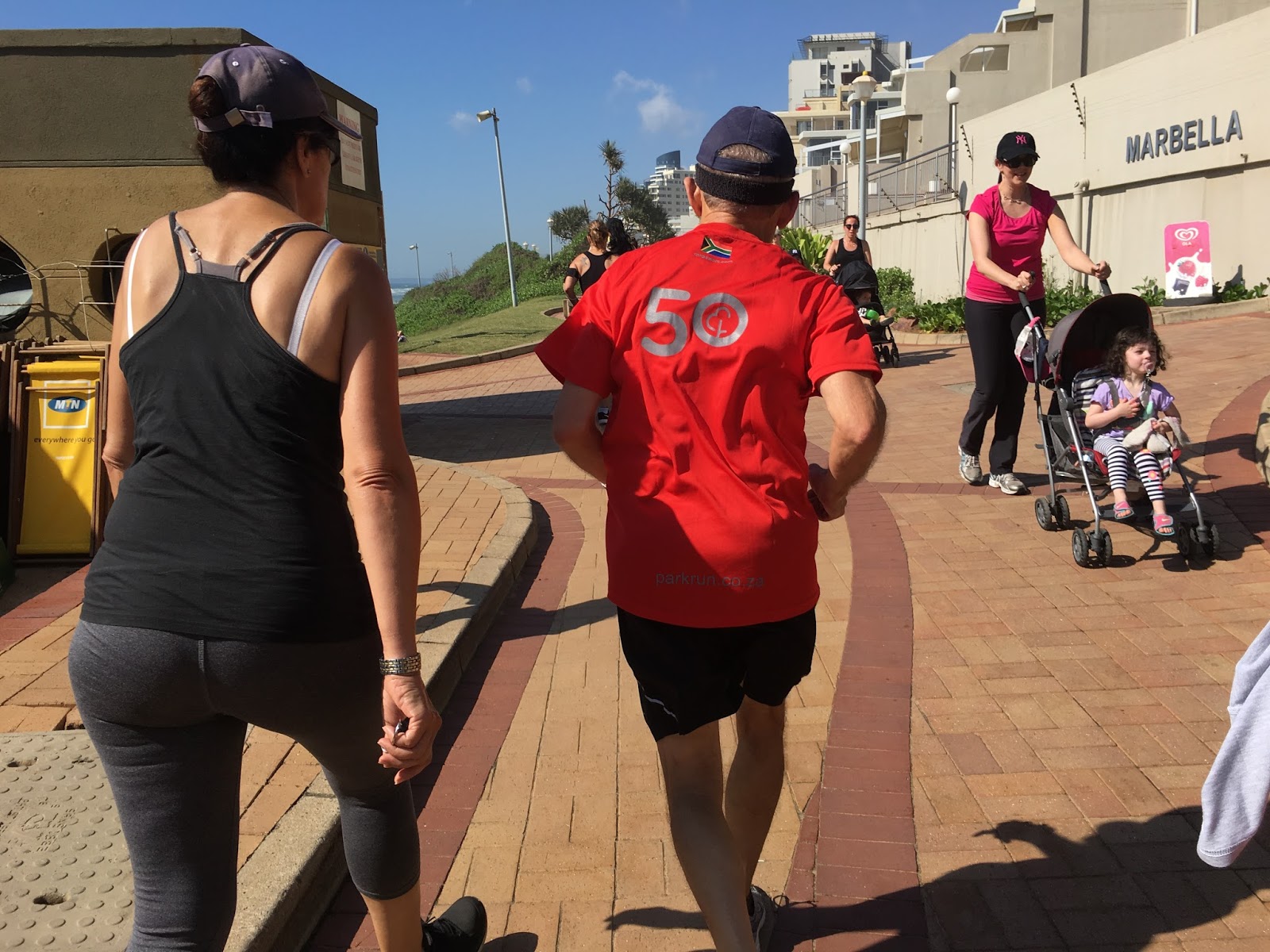
It is day time therefore our night security guard has left. With our key we open then lock the gate in the tall, heavy thick wall.  We walk down the road past high brick walls and dogs which barks at us.  We come to the main road and head for the zebra crossing. We stand and watch the traffic speed past until we get a break in the traffic and cross to a grassy area near a promenade. We walk down the promenade towards the prominent palm tree. The usual variety of shirts is milling around the palm tree. I find a very friendly group of lady runners.  One of them is from Sydney. An amazing coincidence. She is here because was born here in PE and has links to the area.

We talk and more and more people arrive and by 8:00 am a large crowd is milling around the palm tree. A man with a megaphone asks everybody to move back behind the palm tree. I am behind the palm tree way at the back and wander around and watch as crowds wait for others to move back. Further megaphoning and the crowd inches back.  Everybody seems to want to keep their coveted front spot.

At about 8:15 am the race starts and I look at my watch. It takes over one minute before I move. Everybody around me starts walking. I run as much as possible. Dodging, swerving, passing and avoiding walkers and runners.


After about 2 kays the path diverts onto the beach and we run on sand which is surprisingly easy and enjoyable. We then arrive at a rocky area. I rock hop and then run on sand and then I encounter another rock hopping area. I suppose I really could run this area if I really had to but today I don’t.

Chapter 75 : Hobie Beach Parkrun (A)


The day before Hobie Beach Park Run South Africa


I run along the beach front.  I see a lady ahead of me. I speed up and catch up and say, “Good morning.
She replies, “Morning.”
Me, “Do you know where the park run is tomorrow?”
She is pleased with my question. “Yes I do. It starts at that palm tree over there.  (She points).  I do it every week.”
Me, “I’ve come all the way from Tassie to do this run.”

She grimly concentrates on her running and disappears. I now know the spot.  Concrete paths lead up and down the beach from the palm tree.  It is very much a built environment. The beach then the promenade then a busy road then some luxuries houses.  All houses with highly visible security.

Friday, 1 December 2017

Chapter 74 : running drills

Drills are an important part of swimming training. In swimming drills consist of breaking swimming down into distinct parts.  With a kickboard you give the legs an extra hard work out and the arms a rest. With a pull-buoy you can rest the legs and just exercise the arms. There are other drills when you just exercise one side at a time. In swimming there are other drills specifically aimed at improving technique.  Drills are an integral part of swimming training.     

In running drills are virtually ignored. It is easy to go for a run and feel that you have done your training. In a swimming pool it is harder to swim a few laps and have the same feeling.  

I have asked my friend Mr Goggle what he thinks of drills.
Mr G says running drills:

Strengthen key leg muscles. Strengthen not only the muscles, but the specific joints (like the ankle)
Improve the gait.
Improve communication between head and legs. Neuro-muscular co-ordination.
Improve mindfulness of good running technique.
Improve coordination, agility, balance, and proprioception.
Serve as a great warm-up before challenging workouts or races.

And my bottom line is running drills improve my running. I run well, my legs seem to be looser, more coordinated, better balanced, more agile, better able to cope with obstacles on the track or sudden changes in the track.  They seem to help jumps events and the hurdles.
I feel less likely to get an injury and feel like I am running faster. The running is more enjoyable. Less plodding. More lightness. I have no proof or evidence of anything. All I say is try a few drills. You might like them. They might help you.

How often should you do them? I am not training for world records. I do them when I feel like it. I try for a few drills every time I run. Some days I manage more.  I have a routine where I normally do them in the same order. On a good day I do the routine twice or three times. I normally do them before an aerobic run. I find them more tiring than a steady aerobic run.

If you have had an injury then certain drills may be beneficial of harmful. Be aware that previous injuries may influence which drills are good or bad for you.

Normally I do my drills on the DAC or on a local grass soccer field.

And the drills are:

Skipping

Mr G says: skipping increases stride length and knee lift, improves lower-leg strength promoting an efficient midfoot to forefoot strike. And improves balance.
I skip forward raising my leading knee as high as possible. I pump my arms as I do when running but in a more exaggerated fashion.   
I find this very enjoyable. It feels like it is helping with my balance and rhythm. It feels good and I recommend it. If you have a spare moment try a bit of skipping.

Carioca

Mr G says: carioca aids the glutes, abductors, and hips while improving lateral mobility, stability, and coordination.  Carioca lessen your ground contact time and give you a quicker, more efficient turnover.
Move sideways to the left swinging the right leg across in front of the left leg and then behind your left leg. Alternate between swings the right leg in front of and behind you. After a short period change over. Move right with right leg now leading with left leg alternating between swinging in front of and behind you. Arms high and out of way.
My experience is that carioca is confusing and can be stressful on the knees. I am not very fond of this drill.

Backward running

Mr G says: improves the glutes and upper hamstrings and general speed and efficiency. My experience is that running backwards is very helpful. It seems to help balance, co-ordination and all the right muscles. I am definitely a big fan of backwards running.

Butt kicks

Mr G says: run with short strides and try to bring your heel under your butt with each stride. I run slowly and try to raise my foot as high behind me towards butt as possible.   My experience is that this is very tiring. My experience is that this is exercising muscles I don’t normally use. Therefore it must be helping me.

Straight leg

Mr G says: running with straight legs promotes quick leg turnover and improved coordination.
Keep legs straight, run forward, land on midfoot, no high lift of feet. As quick a turnover as possible.
My experience is that this is not very useful or enjoyable.

High knees

Mr G says: run on the spot with fast strides, lifting knees high.  Improves all leg muscles, promotes high knee lift and increasing leg speed.
My experience is that this works. To run on the spot helps. It is a good drill.

Bounding

Mr G says: strengthens all muscles in lower leg.
Lunge forward on one leg.  The leading leg is bent while trailing leg is straight. Hold the lunge position for about 1 second.
I find the only way to do this is very slowly at walking speed. To slowly lunge forward from leg to leg. Not very enjoyable or useful.

Hopping/jumping

Mr G says: strengthens all muscles.
I say it helps a lot. It improves coordination and balance and strengthens muscles and tendons. One of my favourite drills. I interrupt my running with a few meters of hopping or jumping. Either single leg hops or double leg jumps. With the double leg jumps I feel that the takeoff or jump is good. And that the vibrations from the landing are bad.